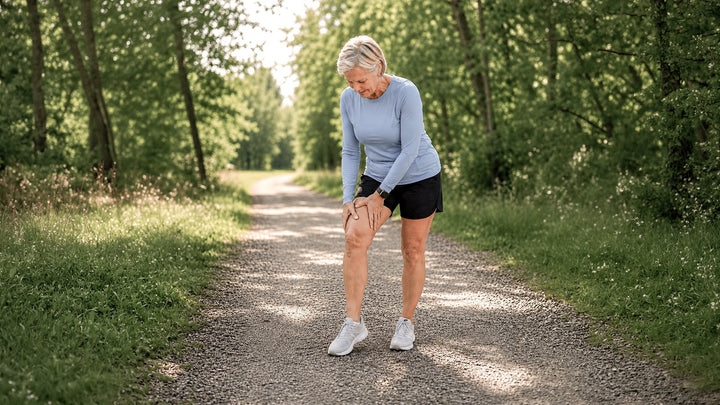
 An injury does not have to mean a long break from everyday life or training. In many cases, the right rehabilitation, started on time and performed regularly, can help you regain strength, mobility, and function faster. For many, rehabilitation at home is a practical and effective option. With simple exercises and some aids, you can create good conditions for recovery – without having to go to a training facility or clinic every day.
However, it is important to remember that all injuries are different. If you have significant problems, severe pain, or uncertainty about your injury, you should always seek medical evaluation. In our injury guide, you can read more about common injuries and problems in, for example, the knee, back, and wrist.
Why is rehabilitation important?
When a joint or muscle is injured, it is common for strength, mobility, and stability to deteriorate for a period. The body quickly adapts to reduced activity, which can make it take longer to return to work, training, or daily activities if rehabilitation is delayed.
Regular rehabilitation can help to:
- restore strength and mobility
- improve stability and body control
- reduce the feeling of stiffness
- increase confidence when returning to activity
- reduce the risk of new problems.
It is rarely individual training sessions that make a difference. Instead, it is the small, regular efforts over time that often yield the best results.
How to succeed with home rehab
Set realistic goals
It can be tempting to want to get back as quickly as possible, but rehabilitation often takes time. Small interim goals make it easier to follow progress and maintain motivation.
Train little but often
Shorter training sessions several times a week are often more effective than doing many exercises on isolated occasions. Regularity helps the body gradually adapt to the load.
Increase the load gradually
As pain decreases and function improves, you can gradually increase the difficulty of the exercises. However, large increases in a short time can lead to the problems returning.
Don't forget recovery
Sleep, rest, and variation in training give the body better conditions to repair and build up tissues.
Products that can help with home rehabilitation
The right aids can make it easier to carry out rehabilitation and create variation in training. Below you will find four products in our range that help you improve mobility, stability, balance, and strength.
- Our ShoulderEx shoulder trainer allows you to actively train your shoulder with reduced load and improve mobility in the shoulder joint.
- Our balance cushion can be used both to train ankle or knee stability after an injury, and for standing or sitting balance training. The difficulty can be adjusted depending on how much air you fill the cushion with.
- Our Uniband exercise bands have a more even resistance when stretched than traditional exercise bands, making them particularly suitable for rehabilitation.
- A training ball is a good tool for training core stability and balance, but can also be used for a range of other exercises. We have training balls in several sizes and a peanut-shaped ball.
See all our exercise equipment
Support when returning to activity
When you start returning to daily activities or training, a brace or support can sometimes contribute to increased security. Below you can read more about four popular braces in our range.
- The Armis ankle brace is a stable and adaptable brace that stabilizes the ankle laterally and provides extra security when returning to sports after, for example, an ankle sprain.
- The Shouldercross shoulder brace stabilizes the shoulder without affecting arm mobility and is a suitable brace for problems such as shoulder dislocation.
- The Ottec knee brace with splints is a suitable knee brace after, for example, a meniscus injury and the need for extra support and relief. It can be used for both sports activities and everyday life.
- Wrist support with unhindered grip is a highly appreciated product. The support has stabilizing splints on both the inside and outside of the wrist, but because the splints on the inside are shorter, hand function is not affected.
It is important to remember that a brace/support does not replace rehabilitation training, but works best as a supplement for a limited period.
When should you seek medical care?
Seek medical evaluation if:
- the pain is severe or worsens
- you have difficulty bearing weight on the injured body part
- you experience pronounced swelling or instability
- you do not notice any improvement despite rehabilitation
- you are unsure about the type of injury you have.
Summary
Home-based rehabilitation can be an effective way to support recovery and return to everyday life and training faster. By training regularly, gradually increasing the load, and using appropriate aids, you can create good conditions for regaining strength, mobility, and function.
Remember that rehabilitation is rarely about doing a lot at once – it's the small steps, performed consistently over time, that often lead to the best results.